EUDR-Ready Wood Packaging Supply Chains: 2026 Manufacturer Guide

EUDR-ready means a wood packaging supplier can produce plot-level geolocation data, supply the documentation an EU importer needs to file a Due Diligence Statement (DDS) in TRACES NT, and pass customs audit. CY Atelier's vertically integrated supply chain delivers this documentation flow for qualifying orders ahead of the 30 December 2026 application date.
The EU Deforestation Regulation (EUDR, Regulation (EU) 2023/1115, amended by Regulation (EU) 2025/2650[1][2]) requires wood packaging placed on the EU market to be backed by a Due Diligence Statement (DDS) by 30 December 2026 for large and medium operators, and by 30 June 2027 for micro and small operators. Being EUDR-ready means three specific things: a supply chain capable of producing plot-level geolocation data on request, documentation flow that supports the first EU operator's DDS submission to TRACES NT, and a sustainability chain (typically FSC Chain of Custody) that reinforces but does not replace EUDR's deforestation-free + legal-harvest verification. This guide explains what European brands should expect from their wood packaging suppliers — and how CY Atelier's vertically-integrated supply chain meets the standard before the application clock starts.
What EUDR Actually Requires from Wood Packaging Exporters
EUDR is not a sustainability certification, and there is no such thing as an "EUDR certificate." It is a regulatory framework, Regulation (EU) 2023/1115[3], that obligates the first operator placing covered goods on the EU market to file a Due Diligence Statement (DDS) confirming three things: the products are deforestation-free, they were produced in compliance with the relevant country's laws, and they are backed by traceable supply chain documentation. For wood packaging, this turns procurement conversations from "is this supplier sustainable" into "can this supplier hand my customs broker an audit-ready DDS reference number on day one." CY Atelier structures its supply chain documentation around that second question, supplying the upstream data — country of harvest, species, and Chain of Custody artefact — that a European brand's importer of record maps to the DDS it files in TRACES NT. That shift is what makes EUDR a procurement issue rather than a brand-positioning claim.

The regulation's scope — when wood packaging is in versus out
EUDR's scope of covered commodities includes wood and articles of wood under HS Chapter 44[4], which captures the great majority of luxury wood packaging products manufactured for the EU market. The critical scope test is whether the wood product is being placed on the EU market as a standalone commodity or used purely as transit protection for another product. A wooden pallet shipped solely to support a separate consumer good in transit is exempt from EUDR. A presentation box that is an integral part of a luxury product offering — sold to a consumer alongside a watch, a bottle of single-malt, a collector edition cigar humidor — is in scope, because the box itself is part of what is being placed on the market. Lawyer- and SaaS-perspective compliance guides often gloss over this distinction; from a manufacturer's perspective, it is the single most important question to answer in any EUDR conversation with a brand.
HS codes covered (Chapter 44, especially HS 4420.90)
The primary HS code for CY Atelier's product portfolio is HS 4420.90: "wood marquetry and inlaid wood; caskets and cases for jewellery or cutlery, and similar articles; statuettes and other ornaments, of wood" — the heading that covers decorative and presentation wooden boxes sold as finished goods. HS 4415 (packing cases, crates, pallets and similar packings of wood) is a different heading that covers transit packaging, and applies only where the wood item exists solely to protect or carry another product. HS 4416 (casks, barrels, vats and other coopers' products) covers a smaller subset relevant to whisky packaging. The broader Chapter 44 covers the full upstream and downstream supply chain — sawn timber, fiberboard, plywood, joinery — which is why MDF substrate sourcing falls under EUDR scope at the upstream mill stage even before the box leaves the factory.
The "packaging-only exemption" and why it doesn't apply to luxury presentation boxes
A common misreading of EUDR is the assumption that anything used to package another product is exempt. The exemption applies narrowly: wood packaging under HS 4415 that solely supports, protects, or carries a separate product is exempt, for example a generic wooden crate transporting industrial machinery. As soon as the wood packaging is itself sold as part of the consumer offering, which is the entire point of a luxury presentation box, the exemption no longer applies. A cigar box, a watch presentation case, a wine and spirits gift box are all in scope under EUDR, because the box is part of what is placed on the EU market. The luxury presentation boxes CY Atelier builds for EU-bound brand orders are sold as part of the consumer offering, not transit protection, which places them squarely inside EUDR scope and requires the full documentation flow the regulation demands.
Who counts as the "operator" — first placer on the EU market
Under EUDR, the "operator" is the first natural or legal person to place a covered product on the EU market. For a CY Atelier shipment imported into Germany by a European brand, the European brand (or its EU-based importer of record) is the operator and the party legally responsible for filing the DDS. The 2025/2650 amendment further simplified the downstream chain: only the first operator files the full DDS in TRACES NT, and downstream operators retain a DDS reference number that they pass through their own documentation. This matters for the manufacturer-side supply chain because it changes what documentation flows where: CY Atelier's role is to provide the upstream data the EU first operator needs to file the DDS, not to file the DDS ourselves.
EUDR Timeline 2026-2027 — What's Real and What's Just Been Postponed
The EUDR timeline has shifted twice since the regulation entered force in mid-2023, and any procurement guide written before December 2025 reflects an outdated set of dates[10]. The current effective application schedule is set by Regulation (EU) 2025/2650[2], adopted by the Council on 18 December 2025 and published in the Official Journal on 23 December 2025. Two compliance dates now matter for European brands sourcing wood packaging: 30 December 2026 for large and medium operators, and 30 June 2027 for micro and small operators. Brands procuring wood packaging from non-EU manufacturers should treat the 2026-12-30 date as the working deadline, because the importer of record on the EU side is almost always a large or medium operator regardless of the manufacturer's company size.
Original schedule, first delay, final amendment
EUDR was originally scheduled to apply on 30 December 2024 for large operators. A first amendment in late 2024 (Regulation (EU) 2024/3234) postponed application by twelve months to 30 December 2025[4]. The second amendment (Regulation (EU) 2025/2650, Council adoption 2025-12-18, Official Journal 2025-12-23, entry into force 2025-12-26) postponed application a further twelve months to 30 December 2026 for large and medium operators, and set 30 June 2027 for micro and small operators[8][12]. The same amendment carved out specific simplifications for downstream operators and SME primary operators, which we cover in the DDS process section below.
Company size | Application date | Key obligation
- Large operators — 30 December 2026 — Full DDS submission to TRACES NT for each batch
- Medium operators — 30 December 2026 — Full DDS submission to TRACES NT for each batch
- Micro and small operators — 30 June 2027 — Simplified DDS — one-time declaration, updates only on major changes
- Micro/small previously covered by EUTR — 30 December 2026 — Aligned with large/medium deadline (legacy obligation)
The simplification amendment (Regulation (EU) 2025/2650): what changed
Beyond the postponement, the 2025/2650 amendment introduced four substantive simplifications that reshape how the DDS process works in practice. First, only the first operator placing on the EU market submits the full DDS to TRACES NT; downstream operators retain a DDS reference number and pass it through their own documentation rather than submitting duplicate filings. Second, small and micro primary operators submit a one-time simplified declaration, with updates only required if major changes occur. Third, non-SME traders no longer submit DDS if they are not directly importing — narrowing scope and reducing administrative burden. Fourth, an estimated annual quantity of regulated products must be included in DDS submissions — a new requirement that affects how manufacturers report production volumes upstream to their EU brand customers.
The Commission's 4 May 2026 simplification review confirmed the deadlines — why brands shouldn't wait
On 4 May 2026 the European Commission delivered its EUDR simplification review (COM(2026) 191 final), confirming both application dates as firm with no further reopening of the regulation's text[9]. Brands and procurement teams treating this date as a reason to delay supplier qualification are taking on avoidable risk: the review is administrative in scope, the December 2026 large-operator application date is set in regulation, and the supplier shortlisting work that buyers need to complete in the second half of 2026 cannot start the week before the deadline hits. Wood packaging supply chains — particularly those involving non-EU manufacturers — require months of documentation review, sample audits, and DDS reference flow testing before a brand can confidently declare a supplier EUDR-ready for the 2026-12-30 cutoff. The 6-month pre-deadline window between mid-2026 and December 2026 is when serious procurement teams will run that work.
The Three-Step Due Diligence Statement (DDS) Process
The Due Diligence Statement is the single document that operationalises EUDR — a structured declaration that the wood placed on the EU market is deforestation-free, legally harvested, and traceable through a documented supply chain[11]. The DDS is not paperwork generated at the end of a shipment; it is the output of a three-step process that begins at the upstream mill and concludes when the EU first operator submits to TRACES NT. For procurement teams evaluating a non-EU wood packaging supplier, understanding what flows through these three steps is the difference between a supplier who can hand over an audit-ready DDS reference number and a supplier who scrambles when the customs broker asks for documentation.
Step 1 — Information collection
The first step of due diligence is supply-chain information collection, and EUDR specifies the data points required. The operator must collect plot-level geolocation polygons identifying where the wood was harvested, the harvest date or date range, the country of production, the species (botanical name), and the identity of every supplier in the chain back to the harvest location. For wood packaging manufactured from MDF, this means the upstream mill provides the polygon data covering the source forests, the manufacturer (CY Atelier in our case) records the substrate procurement chain, and the downstream operator inherits the documentation through the supply contract. The information collection step is where a vertically-integrated supply chain shows its strength — fewer handoffs means fewer points where data integrity can break.
Step 2 — Risk assessment
The second step is risk assessment using the EU's country classification system[1]. The European Commission has classified producing countries as low, standard, or high risk based on deforestation rates, governance indicators, and prevalence of illegal harvest. New Zealand and Australia — the source countries for CY Atelier's MDF substrate — are both classified as low risk under the system, which simplifies the assessment burden for downstream operators sourcing through this supply chain. For low-risk country sourcing, the operator confirms the classification, documents the supplier identity, and does not need to perform extended risk mitigation. For standard or high risk sourcing, additional verification steps apply.
Step 3 — Risk mitigation
The third step applies only when risk is assessed above negligible. Risk mitigation can include additional supplier audits, third-party verification of the supply chain, sample testing for species verification, or substituting the supplier entirely. For a buyer working with a manufacturer whose substrate originates entirely from low-risk Australasian mills, the risk mitigation step is typically not triggered — the documentation pass-through is sufficient. This is one of the practical reasons procurement teams prefer suppliers with low-risk geographic sourcing chains: the DDS process completes faster and with fewer conditional documentation requirements.
TRACES NT submission
TRACES NT, the EU's designated DDS submission system, will accept formal submissions ahead of the December 30, 2026 application deadline; companies are encouraged to test in the EU's available test environment before the formal application date. The system generates a DDS reference number upon submission, which becomes the artefact that downstream operators retain and reference in their own documentation chain. For a wood packaging shipment manufactured in Taichung and imported into Germany, the German importer (acting as the EU first operator) submits the DDS to TRACES NT with the upstream data CY Atelier has provided, and the resulting reference number travels with the goods through any subsequent EU-internal redistribution.
The downstream operator simplification (post-2025/2650)
The 2025/2650 amendment[2] introduced a meaningful procedural simplification: only the first operator placing on the EU market submits the full DDS to TRACES NT, and downstream operators retain the DDS reference number rather than filing duplicates. This change clarifies the role definition for a non-EU manufacturer's documentation deliverable. CY Atelier's responsibility under the amended structure is to supply the upstream data the EU first operator (typically the European brand or its EU-based importer of record) needs to file a single comprehensive DDS. For procurement teams, this clarification matters: when you ask "who submits the DDS for our wood packaging?", the answer for a Taiwan-manufactured shipment imported into Germany is the German importer of record, supported by upstream supplier documentation we provide — and the documentation flow we maintain is what makes that submission audit-ready on day one.
Geolocation Traceability — What's Required and What Stays Confidential
EUDR Article 9 obligates the operator to collect and retain plot-level geolocation polygons identifying the precise origin of the wood placed on the EU market — coordinates in decimal degrees, expressed as polygons for plots larger than four hectares and as single points for smaller plots, accompanied by harvest dates or date ranges. The data sits inside the operator's Due Diligence Statement filing to TRACES NT[1], where it supports the deforestation-free declaration by allowing satellite verification against EU Forest Observatory imagery. For wood packaging procurement teams, the practical question is not "does the regulation require geolocation" — it does — but "what part of that data flow needs to surface in the buyer's documentation, and what stays inside the upstream supply chain." The answer, perhaps counterintuitively, is that buyers should expect to see the DDS reference number, not the raw polygon coordinates.

What EUDR requires — plot-level GPS polygons for harvest origin
The geolocation requirement under EUDR Article 9[1] applies to the harvest plot, not the manufacturing facility. For wood packaging produced from MDF, this means the polygons identify the source forests where the radiata pine (or other species) was grown — typically managed forest plots in New Zealand, Australia, or other producing countries upstream of the substrate mill. Polygons must be expressed in WGS 84 decimal degrees, and the data must be sufficiently precise to allow the EU Forest Observatory to perform deforestation-free verification through satellite imagery comparison against the regulation's December 31, 2020 cut-off date. The technical specification is non-negotiable; the regulation does not accept country-of-origin or region-of-origin declarations as substitutes for plot-level coordinates.
What buyers should expect to see versus what stays internal
Procurement teams evaluating a wood packaging supplier should expect documentation of the supply chain's geolocation capability, not the raw polygon coordinates themselves. The DDS reference number generated by TRACES NT is the artefact that travels with the goods through downstream documentation; the underlying plot-level polygons sit in the EU first operator's TRACES NT filing and in the upstream mill's records, governed by commercial confidentiality between the mill and its forest suppliers. A buyer asking "show me your GPS coordinates" is asking for the wrong document. The right question is "what is the DDS reference number for this batch, and through which trade partner does the chain of custody flow." In CY Atelier's supply chain, that question is answered in days: the reference number and Chain of Custody documentation flow to the EU first operator, while the plot-level polygons stay protected upstream.
How upstream supplier geolocation flows downstream without exposing commercial confidentiality
The flow works through the operator-of-record structure clarified by Regulation (EU) 2025/2650[2]. Upstream mills supplying MDF substrate retain plot-level polygon data sourced from their own forest suppliers, deliver the data to the wood packaging manufacturer (or to the EU first operator directly, depending on the contracted documentation flow), and the EU first operator files the consolidated DDS in TRACES NT. The DDS reference number returned by the system becomes the artefact downstream parties retain. The original polygons remain protected by the contracted confidentiality terms between mill and forest, and between mill and downstream operator. This structure is what allows European brands to procure EUDR-compliant wood packaging from non-EU manufacturers without forcing the upstream forest data into the public commercial chain.
The right procurement question for EUDR readiness
EUDR readiness is often reduced in procurement conversations to a single yes/no question — "do you have geolocation data?" That framing misses what auditors actually verify. Under the EU Deforestation Regulation, the compliance unit is not a coordinate file; it is a Due Diligence Statement (DDS) submitted to TRACES NT, supported by an end-to-end documentation flow that connects HS-coded shipments back to legally sourced plots of origin.
When evaluating a wood packaging supplier for EU-bound orders, the more useful question is not "what tracking technology do you use?" but "can your supply chain produce a DDS-aligned documentation flow that survives a customs audit?" The first question buys a feature. The second buys compliance.
FSC vs EUDR — Why FSC Is Necessary But Not Sufficient
A common procurement misconception, often inherited from pre-2024 sustainability vocabulary, is that an FSC Chain of Custody certificate "covers" EUDR compliance. It does not, and the gap determines what documentation a buyer must request from a wood packaging supplier in 2026. FSC certification verifies that wood moves through a sustainable sourcing chain with documented custody handoffs from forest to finished product; EUDR additionally requires plot-level geolocation polygons, EU country-classification risk assessment, and a Due Diligence Statement filed by the first operator placing goods on the EU market. The two frameworks overlap on supply chain documentation hygiene, but EUDR's deforestation-free and legal-harvest verification adds obligations no FSC certificate alone can satisfy. For qualifying orders, CY Atelier's supply chain delivers FSC-certified materials and the EUDR-aligned documentation flow as one coordinated package, so a buyer relying on "we're FSC certified" alone is not left exposed when the customs broker asks for the DDS reference number.
What FSC Chain of Custody guarantees
The FSC Chain of Custody (CoC) standard verifies that wood-based materials moving through a supply chain originate from FSC-certified forests (or controlled wood sources) and that custody handoffs at each processing stage are documented and traceable[5]. A CoC-certified operator must demonstrate that FSC-claimed material is segregated or volume-credit-tracked from non-certified material, that processing records show input-output reconciliation, and that the certificate holder has passed an annual third-party audit by an FSC-accredited certification body[7]. The CoC framework guarantees the sourcing chain — that the wood originated from a forest the FSC system recognises as responsibly managed, and that the chain back to that forest is documented through certificate holders at each stage. What CoC does not guarantee is plot-level geolocation precision; the system was designed for sustainability-claim integrity, not for the satellite-verifiable harvest-origin coordinates EUDR now requires.
What EUDR additionally requires
EUDR adds three obligations that sit on top of (not in place of) sustainable sourcing verification. First, plot-level geolocation polygons identifying the specific harvest plots — coordinates in WGS 84 decimal degrees, polygons for plots over four hectares, single points for smaller plots, with harvest dates[1]. Second, risk assessment using the EU's country classification system (low, standard, or high risk), which determines whether additional risk mitigation is triggered. Third, the Due Diligence Statement itself, filed by the first operator placing the goods on the EU market in TRACES NT, with the resulting DDS reference number travelling downstream through the documentation chain[2]. None of these three requirements are part of the FSC CoC framework. A supply chain can be fully FSC-certified and still fail EUDR compliance if it cannot deliver the polygon data, the country-risk classification, or the DDS reference number on the timeline the December 30, 2026 large-operator application date demands.
The gap — FSC certificate alone cannot satisfy EUDR's plot-level geolocation requirement
The structural gap is geolocation precision. FSC CoC documentation typically references the certified forest unit (a managed forest area certified under an FSC Forest Management certificate), not the harvest plot within that forest unit where a specific batch of wood was cut. EUDR requires the plot-level polygon for the specific harvest, which is a finer-grained data point than CoC documentation typically carries. For wood packaging manufactured from MDF, this means the upstream mill must additionally collect and retain plot-level harvest data from its own forest suppliers, separate from (and in addition to) the FSC CoC documentation that has historically governed sustainability claims. The buyer's question "do you have FSC?" is necessary but insufficient; the EUDR-aligned procurement question is "can your supply chain deliver plot-level polygon data plus the FSC CoC certificate plus the DDS reference number in a single coordinated documentation package."
How FSC Trace bridges the gap
FSC has responded to the geolocation gap with FSC Trace[5], a voluntary EUDR-aligned add-on platform that allows FSC certificate holders to attach plot-level geolocation data to their existing CoC documentation. The platform is designed to integrate FSC's chain-of-custody documentation with the EUDR Article 9 plot-level polygon requirement, reducing the duplication burden for supply chains already operating under FSC certification. For wood packaging supply chains, FSC Trace participation by an upstream mill (or by the certified trade partner holding the CoC certificate) means the geolocation polygon data flows alongside the FSC custody chain rather than as a separate parallel documentation track. FSC Trace adoption is voluntary, not yet universal, and procurement teams should confirm with their suppliers' certificate holders whether FSC Trace is in active use for their specific supply chain or whether the geolocation data flow is being managed through a separate process — including parallel certification-side initiatives such as PEFC TimberID[6], which addresses similar plot-level traceability requirements through the PEFC chain.
Practical scenario — Track A (FSC + EUDR) buyer flow
For a European brand procuring FSC-certified wood packaging from CY Atelier (the supply chain configuration we describe as Track A), the integrated documentation flow works as follows. Substrate originates from low-risk Australasian mills with plot-level geolocation data retained at the mill level. CY Atelier coordinates production across specialist facilities in Taiwan's central manufacturing corridor — directing sourcing, CNC machining, lacquer finishing, and hardware assembly across the network under one coordinating standard. A certified trade partner within our supply chain holds the FSC Chain of Custody certificate and issues the final FSC invoice; the same trade partner relationship supports the DDS reference flow to the EU first operator (typically the European brand or its EU-based importer of record). The full mechanics of this three-stage transaction structure — and the supplier-side documentation we maintain to support it — are detailed in the next section. For now, the procurement-team takeaway is this: the Track A configuration delivers FSC-certified materials through our supply chain for qualifying orders, with the EUDR-aligned documentation flow built into the same transaction structure, so the buyer receives a coordinated FSC + EUDR documentation package rather than two separate sustainability and compliance threads.
The comparison at a glance
The table below summarises which compliance requirements each framework covers, and where the two frameworks need to be combined:
Compliance requirement | FSC Chain of Custody | EUDR | Both Required
- Sustainable sourcing verification (forest management certification) — FSC: Yes (core) — EUDR: No — FSC carries this
- Legal harvest verification (national forestry law compliance) — FSC: Yes (controlled wood basis) — EUDR: Yes (DDS legality declaration) — Reinforcing
- Plot-level geolocation polygons (WGS 84 decimal degrees) — FSC: No (forest-unit level) — EUDR: Yes (Article 9 requirement) — EUDR adds this
- Country risk classification (low / standard / high) — FSC: No — EUDR: Yes (DDS step 2) — EUDR adds this
- DDS filing to TRACES NT (with reference number) — FSC: No — EUDR: Yes (first operator obligation) — EUDR adds this
- Annual estimated quantity reporting — FSC: No — EUDR: Yes (post-2025/2650 amendment) — EUDR adds this
- Chain of Custody documentation (custody handoffs documented) — FSC: Yes (core) — EUDR: Yes (supply chain traceability) — Both required
- Third-party audit (annual surveillance by accredited body) — FSC: Yes (FSC-accredited CB) — EUDR: Indirect (operator audits) — FSC carries this
The table makes the structural relationship visible: FSC CoC is necessary infrastructure for any supply chain claiming sustainable sourcing, but EUDR adds four substantive requirements that FSC CoC alone does not cover. A buyer evaluating a wood packaging supply chain should expect both — FSC-certified materials for the sourcing-chain integrity and EUDR-aligned documentation flow for the regulatory compliance — delivered as a coordinated package. To see how CY Atelier's supply chain integrates both frameworks, our sustainability hub explains the full Track-A documentation flow.
How CY Atelier's Supply Chain Meets EUDR Requirements
CY Atelier coordinates a vertically integrated wood packaging supply chain network across Taiwan's central manufacturing corridor — sourcing premium E0/P2 MDF from responsibly managed Australasian mills, including Nelson Pine Industries (New Zealand) and The Laminex Group (Australia), and directing CNC machining, lacquer finishing, and hardware assembly across specialist facilities under one coordinating standard. For qualifying orders, our supply chain delivers FSC-certified materials and full Chain of Custody documentation through a certified trade partner who holds the CoC certificate and issues the final FSC invoice. The supply chain is EUDR-ready with documentation validated through German, Japanese, and US customs review and ongoing audits by European brand customers. This is the configuration we describe to procurement teams as Track A — FSC + EUDR documentation flowing as a single coordinated package, with plot-level geolocation polygons sourced upstream from low-risk Australasian mill suppliers and the DDS reference number reaching the EU first operator on the timeline a December 30, 2026 audit demands. The same network produces the custom wood packaging we make for European brands, from cigar and watch boxes to wine and spirits presentation cases.
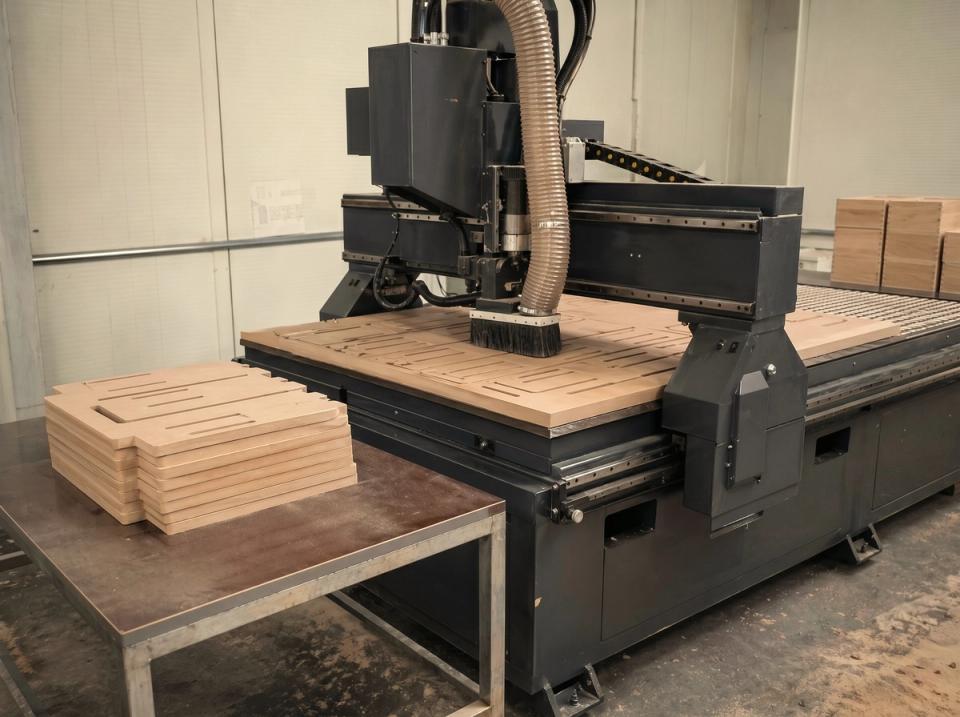
Vertical integration across a coordinated supply chain network
Most wood packaging supply chains move material across three or four independent processors — substrate mill, CNC shop, lacquer house, hardware assembler — with each handoff introducing a documentation gap that EUDR's traceability requirement now exposes. CY Atelier coordinates sourcing, CNC machining, lacquer finishing, and hardware assembly across specialist facilities held to one coordinating standard, which is why the documentation flow we deliver to European buyers reads as one coordinated chain rather than four stitched-together statements. For a vertically-integrated wood packaging manufacturer, the EUDR documentation pass-through is structurally simpler — fewer custody handoffs means fewer points where plot-level provenance data can break.
Australasian MDF sourcing and Track A documentation flow
Our substrate originates from radiata pine forests in New Zealand and Australia — both classified as low-risk countries under the EU country classification system, which simplifies the DDS Step 2 risk assessment for downstream operators. The MDF carries E0/P2 formaldehyde grading and meets the dimensional and surface specifications luxury presentation boxes require; the role of premium E0/P2 MDF in our supply chain is detailed in the substrate companion article. Under Track A, plot-level geolocation polygons retained at the upstream mill level flow downstream through our certified trade partner's documentation chain, alongside the FSC Chain of Custody artefact, reaching the EU first operator as a single coordinated package. The trade partner — anonymous by commercial convention, never named publicly — holds the CoC certificate and issues the final FSC invoice; CY Atelier leads production and supplies the upstream documentation the trade partner consolidates.
Validated through German customs and European brand audits
Documentation flow is only useful if it survives audit conditions. Our supply chain documentation has passed German customs review for incoming wood packaging shipments and continues to undergo European brand audit cycles initiated by procurement teams qualifying suppliers for the December 2026 application date. These are not internally-generated certifications — they are external verification events conducted by parties whose job is to find documentation gaps. The audit-ready posture matters because it converts EUDR compliance from a forward-looking commitment into a present-tense capability: when a brand's customs broker requests the DDS reference number on day one of a shipment's EU arrival, our supply chain has already done the work upstream to make that request a routine pass rather than a scramble.
Audit-Ready Documentation Checklist Your European Buyer Will Request
When a procurement team qualifies a non-EU wood packaging supplier for the December 30, 2026 EUDR application date, documentation requests arrive in three predictable tiers. Tier 1 is the must-have artefact set: a DDS reference number from TRACES NT, country of harvest declaration, species declaration (botanical name, e.g., Pinus radiata), an FSC Chain of Custody certificate held by our certified trade partner under the Track A configuration, and a supplier risk classification mapped to EU country tiers (low, standard, or high risk). Tier 2 reinforces audit defensibility: an annual third-party audit summary from the FSC-accredited certification body, a supplier sustainability statement, and customs declaration history. Tier 3 reaches deep due diligence: upstream mill audit reports plus plot-level polygon data flowing through the documentation chain to the EU first operator.
Tier 1 — Must-have documentation
Every European buyer's customs broker requests this set on day one of EU arrival. CY Atelier's Track A configuration delivers all five artefacts as one coordinated package — DDS reference number, country of harvest (New Zealand or Australia), species declaration, the FSC CoC certificate held by our certified trade partner who issues the final FSC invoice, and the low-risk country classification declaration.
Tier 2 — Recommended supporting documentation
Tier 2 reinforces audit defensibility under deeper supplier review. The annual third-party audit summary from the FSC-accredited certification body and customs declaration history (including German customs review pass) are most commonly requested at this tier, available on request through our capabilities documentation.
Tier 3 — Deep due diligence (including supplier-side geolocation flow)
Tier 3 is where the upstream supply chain's data flow becomes visible. Plot-level polygon data sourced from upstream mill suppliers (retained at the mill level under commercial confidentiality) flows through the documentation chain to the EU first operator's TRACES NT filing. The buyer-side artefact is the DDS reference number; underlying polygons stay protected.
A note for IB (Independent Bottler) and small-batch luxury procurement
IB procurement — for example a limited-edition single-cask release by an independent bottler — follows the same three-tier framework, scaled to small-batch volumes. Anonymity is the commercial norm in IB sourcing, and the Track A flow handles small-batch FSC + EUDR procurement on the same audit-ready basis as larger orders — which is why our wine and spirits boxes portfolio supports both volume and small-batch luxury procurement.
Common Buyer Questions
Q1 — Is FSC certification enough for EUDR compliance?
Not on its own. FSC Chain of Custody is one of five Tier 1 must-have artefacts. EUDR additionally requires plot-level geolocation polygons, EU country-risk classification, and a DDS reference number from TRACES NT — three obligations that complement rather than replace FSC.
Q2 — Are wood pallets covered by EUDR?
It depends on use. A wooden pallet sold as a standalone commodity falls under HS 4415 and is in scope. A pallet used purely as transit packaging to support a separate consumer good is exempt under the packaging-only exemption. The distinction is whether the pallet itself is being placed on the EU market.
Q3 — Does EUDR apply to luxury wood gift boxes?
Yes. A luxury presentation box sold alongside a watch, single-malt bottle, or collector cigar humidor is a finished good under HS 4420.90 and is in scope, because the box itself is part of what is placed on the EU market. The packaging-only exemption applies narrowly to pure transit packaging under HS 4415, not to integral consumer-offering boxes.
Q4 — What if my wood packaging supplier is not in the EU?
Your supplier provides upstream Tier 1 documentation — country of harvest, species, supplier risk classification, and FSC Chain of Custody artefact — plus Tier 3 plot-level polygon data flowing from the upstream mill. The EU first operator (your importer of record) files the DDS to TRACES NT using that pass-through data.
Q5 — Who submits the DDS — the manufacturer in Taiwan or the importer in Germany?
The German importer, acting as the EU first operator, submits the DDS to TRACES NT. CY Atelier supplies the upstream documentation — Tier 1 country classification, species, and the FSC artefact, plus Tier 3 polygon flow — so the DDS reference number reaching the EU first operator is audit-ready on day one.
Q6 — How does EUDR change the way I procure wood packaging?
The procurement question shifts from "is this supplier FSC certified" to "can this supplier deliver Tier 1, Tier 2, and Tier 3 documentation as a coordinated package on the timeline our customs broker needs." The three-tier framework replaces single-certificate supplier qualification as the new procurement-onboarding shape.
Q7 — Will CY Atelier be ready by the December 30, 2026 application date?
Yes. For qualifying orders, our supply chain delivers FSC-certified materials and full Chain of Custody documentation through a certified trade partner who holds the CoC certificate and issues the final FSC invoice. Documentation has been validated through German customs review and ongoing European brand audits — present-tense capability, not forward commitment.
Q8 — When does EUDR apply to EU small and medium operators?
30 June 2027 for micro and small operators per Regulation (EU) 2025/2650. Brands sourcing wood packaging from non-EU manufacturers should still treat 30 December 2026 as the working deadline, because the EU importer of record is almost always a large or medium operator regardless of manufacturer size.
Closing — The Six-Month Procurement Window
The procurement teams who will close 2027 RFQs with confidence are the ones running supplier qualification work between mid-2026 and the December 30, 2026 large-operator application date — not the week before. Two practical takeaways close this guide. First, the right procurement question is not "are you FSC certified" but "can you deliver the DDS reference number, the FSC Chain of Custody artefact, and the upstream documentation flow as a single coordinated package on the timeline our customs broker needs." Second, supplier shortlisting under EUDR is a documentation-flow audit, not a sustainability-certification check; the suppliers who pass the December 2026 audit are the ones who treat compliance as present-tense capability, not forward commitment. For European brands evaluating wood packaging supply chains for 2027 production cycles — particularly procurement teams sourcing through a Track A configuration combining FSC and EUDR documentation — the work of qualifying a vertically-integrated manufacturer against both frameworks starts now. FSC, FLEGT, EUTR, and EUDR each handle documentation responsibility differently within EU wood compliance frameworks; recognising the practical differences across all four is part of the supplier qualification work this six-month window demands.
References
- European Commission. EU Deforestation Regulation: Regulation on deforestation-free products. Directorate-General for Environment. environment.ec.europa.eu/topics/forests/deforestation/regulation-deforestation-free-products_en
- Council of the European Union. Deforestation: Council signs off on targeted revision to simplify and postpone the regulation. Press release, 18 December 2025. consilium.europa.eu/en/press/press-releases/2025/12/18/deforestation-council-signs-off-targeted-revision-to-simplify-and-postpone-the-regulation/
- European Union. Regulation (EU) 2023/1115 of the European Parliament and of the Council of 31 May 2023 on the making available on the Union market and the export from the Union of certain commodities and products associated with deforestation and forest degradation. Official Journal of the European Union, L 150/206, 9 June 2023. eur-lex.europa.eu/eli/reg/2023/1115/oj
- European Commission, Directorate-General for Trade. Delay until December 2026 and other developments in implementation of the EUDR Regulation. Access2Markets news, 2025. trade.ec.europa.eu/access-to-markets/en/news/delay-until-december-2026-and-other-developments-implementation-eudr-regulation
- Forest Stewardship Council. EUDR Simplification: What it means for wood and rubber. FSC News Centre, 2025. fsc.org/en/newscentre/eudr/eudr-simplification-what-it-means-for-wood-and-rubber
- Programme for the Endorsement of Forest Certification (PEFC). TimberID: Trusted supply chain solution to ensure EUDR compliance. PEFC News, 2025. pefc.org/cms/b999fadb-8521-4d4f-8d3c-4688f57fdced/news/10001145/timberid-trusted-supply-chain-solution-to-ensure-eudr-compliance
- SCS Global Services. Achieve EUDR Compliance for Wood: Resources for forest products manufacturers. SCS Global Services Resources, 2025. scsglobalservices.com/resources/achieve-eudr-compliance-for-wood
- Coolset. EUDR Delay 2025 Explained: Timeline and simplification deep-dive. Coolset Academy, 2025. coolset.com/academy/eudr-delay-2025-explained
- osapiens. EUDR Postponement 2026: What companies should do. osapiens Blog, 2025. osapiens.com/blog/eudr-postponement-2026-what-companies-should-do/
- Norton Rose Fulbright. Update on EU Deforestation Regulation (EUDR) — Towards simplified implementation. Norton Rose Fulbright Knowledge Publications, 2025. nortonrosefulbright.com/en/knowledge/publications/67068c0e/update-on-eu-deforestation-regulation-eudr--towards-simplified-implementation
- World Wide Fund for Nature (WWF). EUDR Step-by-Step Business Guide: Timber Annex v1. WWF EU Resources, 2025. wwfeu.awsassets.panda.org/downloads/eudr-guide_timber-annex_v1.pdf
- CMS Law. EU resets the countdown on the EUDR and postpones the regulation once again. CMS Legal Updates, 2025. cms.law/en/deu/legal-updates/eu-resets-the-countdown-on-the-eudr-and-postpones-the-regulation-once-again